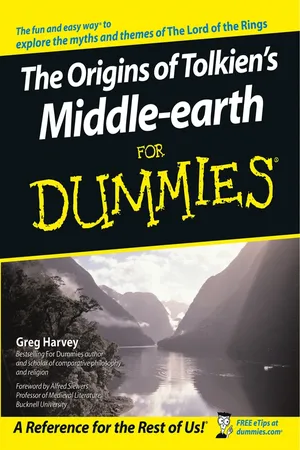
The Origins of Tolkien's Middle-earth For Dummies
eBook - ePub

The Origins of Tolkien's Middle-earth For Dummies

  1. English
  2. ePUB (mobile friendly)
  3. Available on iOS & Android
eBook - ePub

The Origins of Tolkien's Middle-earth For Dummies

About this book

J.R.R. Tolkien's novels of Middle-earth – The Hobbit, The Lord of the Rings trilogy, and The Silmarillian – have become some of the most famous, and most beloved, literary works of the twentieth century. And the Lord of the Rings films by director Peter Jackson have re-ignited interest in Tolkien and his works, as well as introduced his stories to a new generation of fans.

Even if you've never read the novels and have only seen the films, you know that the world of Middle-earth is a complicated one. Tolkien took great care in representing this world, from creating new languages to including very particular cultural details that add to the richness of the world's fabric. Many other books have been written about Tolkien and his works, but none have come close to providing the kind of reference needed to comprehend the world of Middle-earth. That's what veteran Dummies author and unabashed Tolkien fan Greg Harvey attempts to do in The Origins of Tolkien's Middle-earth For Dummies.

As the author says in his introduction to the book, this is not an encyclopedia or quick guide to all the diverse beings, languages, and history that make up Tolkien's Middle-earth. Nor is it a set of plot outlines for the novels. Rather, what you'll find in The Origins of Tolkien's Middle-earth For Dummies is a basic guide to some of the possible linguistic and mythological origins of Middle-earth, plus a rudimentary analysis of its many themes and lessons for our world. This book can help enrich your reading (or re-reading) of Tolkien's novels, and it will challenge you to think about the themes inherent in Tolkien's Middle-earth and their implications in your own life.

Here's just a sampling of the topics you'll find covered in The Origins of Tolkien's Middle-earth For Dummies:

  • Exploring the main themes in Tolkien's works, including immortality and death; the heroic quest; love; fate and free will; and faith and redemption
  • Investigating the diverse lands of Middle-earth – including the Shire, Gondor, and Mordor – and their significance
  • Examining the different cultures of Middle-earth, such as Hobbits, Elves, Men, and those wily Wizards
  • Touring the history of Middle-earth
  • Understanding Tolkien's creation of new languages to enrich the story of Middle-earth
  • Top Ten lists on the battles in the War of the Ring, online resources, and the ways the films differ from the novels

So, whether you're reading Tolkien's novels or watching the films for the first time, or you've been a fan for many years and are looking for a new take on Tolkien's works, The Origins of Tolkien's Middle-earth For Dummies can help you enhance your reading or viewing experience for years to come.

Trusted by 375,005 students

Access to over 1.5 million titles for a fair monthly price.

Study more efficiently using our study tools.

Information

Publisher
For Dummies
Year
2011
Print ISBN
9780764541865
Edition
1
eBook ISBN
9781118068984
Part I

The Geography of Middle-earth

In this part . . .
**IN a DROPCAP**
Where exactly is Tolkien’s Middle-earth, and what kind of world is it anyway? Part I provides answers to these questions by giving you a general introduction to the many realms and lands that Middle-earth encompasses and, in so doing, orients you to the rest of the book. This part investigates the relationship between the world of Middle-earth and our world, while giving you an overview of the wide and varied landscape that this world entails.
Chapter 1

The Worlds of Middle-earth

In This Chapter

bullet
The location and origin of Middle-earth
bullet
Tolkien’s idea of fantasy
bullet
The underlying mythology of Middle-earth
bullet
Tolkien’s strange and wonderful beings
bullet
The historical framework of Middle-earth
bullet
Middle-earth’s diverse languages
I n its broadest sense, geography is the study of the physical features of the world as well as its biological and cultural characteristics. When attempting to deal with the “geography” of a fantasy world like Middle-earth, as envisioned by J.R.R. Tolkien, you’re almost compelled to use this wider definition, even if your only goal is to get an overview of its many features. For Tolkien’s Middle-earth is never just one of physical geography filled with strange lands, weird creatures, and unfamiliar cultures. As Tolkien conceived it over the better part of his life, Middle-earth is also a world rich in its own mythology, history, and languages.
This chapter gives an overview of the various worlds that await you in your journey to Tolkien’s Middle-earth, while at the same time familiarizing you with how these realms are covered in the rest of the book. It opens by exploring the questions of where exactly Middle-earth is located and why Tolkien chose the name Middle-earth for his fantasy world. The chapter then looks at Middle-earth as a fantasy realm in light of Tolkien’s ideas on the importance of fairytale in our lives. The chapter concludes with an overview of the creatures, history, and languages with which Tolkien filled his world of Middle-earth.

Where in the World Is Middle-earth?

You may well wonder why it’s important at all to locate Middle-earth. Does it really matter whether Middle-earth is a future world in another galaxy or a Europe long gone? Would it really detract from your enjoyment of Bilbo’s journey to the Lonely Mountain or Frodo’s quest from the Shire to Mount Doom if you found out that Middle-earth were nowhere on this earth?
I happen to feel that Tolkien drew Middle-earth so well in The Hobbit and told the story of The Lord of the Rings so tightly that it wouldn’t matter a whit if he had started off either story with the now famous declaration from George Lucas’ Star Wars saga, “Long, long ago in a galaxy far, far away . . . ” On the other hand, coming to know how much Middle-earth owes to past European sagas, legends, and languages can only enhance appreciation of his works and deepen understanding of their many lessons.
Associating Middle-earth with our world and not some alien planet or invisible dimension was very important to Tolkien. When pressed for the location of Middle-earth (as fans and critics continually did), Tolkien often replied that Middle-earth most definitely refers to lands of this world. In his letter commenting on a review of The Lord of the Rings by W. H. Auden, he wrote, “Middle-earth is not an imaginary world.” He then declared that his Middle-earth is “the objectively real world” as opposed to an imaginary world such as Fairyland or invisible ones such as Heaven or Hell.
In another letter responding to a draft of a Daily Telegraph article for which he was interviewed, Tolkien said that the stories in The Hobbit and The Lord of the Rings take place in the “north-west of ‘Middle-earth,’ equivalent to the coastlands of Europe and the north shores of the Mediterranean.” He then went on to fix some of the primary locations in his books by stating that if you placed Hobbiton and Rivendell at the latitude of Oxford (which was his intention), then Minas Tirith, some 600 miles south in Gondor, would be at approximately the same latitude as Florence, Italy. This puts the Mouths of the river Anduin and the ancient Gondorian city of Pelagir at about the same latitude as the fabled city of Troy (made famous in Homer’s heroic epic poem the Iliad and located on the west coast of modern-day Turkey).
To get an idea of these spatial relationships, see Figure 1-1, which shows the western coastline of Middle-earth and points out the specific parallel locations that Tolkien pinpointed in his letter. From this map, you’d be hard pressed to match any of Middle-earth’s physical features with those of modern-day Europe. Tolkien would have explained this obvious discrepancy as the result of changes in coastal geography during the time that has elapsed since his epic adventures took place. To me, it’s sort of like the difference between Earth’s Jurassic age and the Middle Ages — not too much looks the same, but it’s the same old Earth.
Figure 1-1: Middle-earth’s coastline super-imposed on Western Europe.

The Meaning of Middle-earth

In the letter commenting on a New York Times book review, Tolkien stated that the name Middle-earth is a “just a use of Middle English midden-erd (or erthe) , altered from Old English Middangeard, the name for the inhabited lands of Men ‘between the seas’ . . .”

The origin of the term “Middle-earth”

Midden-erde (or erthe ), however, is good old Middle English for “middle-earth.” As Tolkien pointed out, it hails from an earlier form, middangeard, which literally means the “middle yard” in Old English or Anglo-Saxon, the language Tolkien taught at Oxford University. Middangeard was taken to mean, like oikumenos, the “inhabited world.” It is rumored that Tolkien first happened upon this term as an undergraduate student when he read the following lines in Crist (Christ) , an Old English poem attributed to a bard named Cynewulf:
Éala Éarendel engla beorhtast ofer middangeard monnum sended
In my translation, this reads, “Hail, Earendel, the brightest of angels sent to the world of men!” In this early form, Middle-earth was not only the inhabited lands in the midst of the encircling seas, but also the middle ground between Heaven above and Hell below. This vertical dimension of the early European Christian Middle-earth is entirely missing from Tolkien’s — even though you’d be hard pressed to find a more devout Catholic Christian.

“Stuck in the middle again . . . ”

At the time when The Hobbit and The Lord of the Rings take place, the inhabited lands of Middle-earth are surrounded on three sides by wastelands and on the west by open sea. To the north lies the Ice Bay of Forochel, and beyond that is the frozen Northern Waste; to the east is RhĂ»n, populated by the barbaric Easterlings. To the south you find the vast deserts of Harad, populated by dark-skinned peoples called the Haradrim (“Southerns”). In The Lord of the Rings, both Easterlings and Southrons often make war on the free peoples of Middle-earth and are allied with Sauron, Dark Lord of the eastern realm of Mordor, who is the greatest threat to freedom in Middle-earth.
On the west, many of the lands of Middle-earth, just like many lands of Europe, have borders that adjoin the sea. According to Tolkien’s thinking, at the time of The Hobbit and The Lord of the Rings, you could sail west and not find any other land masses (you certainly wouldn’t discover the Americas). In earlier ages, though, sailing directly west would bring you to the island of NĂșmenor, the ancient homeland of the people who end up settling the northern and southern coasts of Middle-earth. And west of NĂșmenor lay the continent of Aman — the so-called Blessed Realm or Undying Lands (see Chapter 2). Aman is where two types of immortal beings, the Valar and Elves, dwell together. By the Third Age, the one in which The Hobbit and The Lord of the Rings take place, the island of NĂșmenor has sunk beneath the sea, and Aman, removed from the physical plane of the world, is accessible only by the magic White Ships of the Elves (see Chapter 12).
Viewed from this perspective, you can start to understand how the peoples of Tolkien’s Middle-earth perceive their lands as being encircled by limiting forces, some of which are hostile. This viewpoint is perhaps not so unlike the Anglo-Saxons before they came to Britain, when they still dwelt along the northwestern coast of Europe in the lands now known as Denmark and northwest Germany. At that time, they were surrounded on three sides by potentially hostile tribes and the open sea on the other. The situation didn’t change much when they got to England, except that the sea was mostly at their back with the hostile Celts in front and on either side of them. I think that much of the orientation of Middle-earth’s geography is rooted in the perspective of Tolkien’s Anglo-Saxon ancestors, whose language he knew...

Table of contents

  1. Title
  2. Contents
  3. Introduction
  4. Part I : The Geography of Middle-earth
  5. Chapter 1: The Worlds of Middle-earth
  6. Chapter 2: The Lands of Middle-earth and Beyond
  7. Part II : The Beings of Middle-earth
  8. Chapter 3: The Divine Ainur
  9. Chapter 4: The Fair Race of Elves
  10. Chapter 5: The Mortal Race of Men
  11. Chapter 6: The Hardy Race of Dwarves
  12. Chapter 7: Those Homespun Hobbits
  13. Chapter 8: The Wily Wizards
  14. Chapter 9: Beorn, Tom Bombadil, and Treebeard
  15. Chapter 10: The Enemy and His Minions
  16. Part III : The History of Middle-earth
  17. Chapter 11: The Valarian Ages
  18. Chapter 12: The First Three Ages and Then Some
  19. Part IV : The Languages of Middle-earth
  20. Chapter 13: Tolkien and Language
  21. Chapter 14: The Tongues of Tolkien
  22. Part V : The Themes and Mythology of Middle-earth
  23. Chapter 15: The Struggle Between Good and Evil
  24. Chapter 16: Immortality and Death
  25. Chapter 17: The Heroic Quest
  26. Chapter 18: Chivalry and True Love
  27. Chapter 19: Fate and Free Will
  28. Chapter 20: Faith and Redemption
  29. Chapter 21: Ring-related Myths
  30. Chapter 22: Ecological Themes
  31. Chapter 23: Sex and Gender
  32. Part VI : The Part of Tens
  33. Chapter 24: Top Ten Battles in the War of the Ring
  34. Chapter 25: Top Ten Online Middle-earth Resources
  35. Chapter 26: Top Ten Ways the “Lord of the Rings” Books Differ from the Movies

Frequently asked questions

Yes, you can cancel anytime from the Subscription tab in your account settings on the Perlego website. Your subscription will stay active until the end of your current billing period. Learn how to cancel your subscription
No, books cannot be downloaded as external files, such as PDFs, for use outside of Perlego. However, you can download books within the Perlego app for offline reading on mobile or tablet. Learn how to download books offline
Perlego offers two plans: Essential and Complete
  • Essential is ideal for learners and professionals who enjoy exploring a wide range of subjects. Access the Essential Library with 800,000+ trusted titles and best-sellers across business, personal growth, and the humanities. Includes unlimited reading time and Standard Read Aloud voice.
  • Complete: Perfect for advanced learners and researchers needing full, unrestricted access. Unlock 1.5M+ books across hundreds of subjects, including academic and specialized titles. The Complete Plan also includes advanced features like Premium Read Aloud and Research Assistant.
Both plans are available with monthly, semester, or annual billing cycles.
We are an online textbook subscription service, where you can get access to an entire online library for less than the price of a single book per month. With over 1.5 million books across 990+ topics, we’ve got you covered! Learn about our mission
Look out for the read-aloud symbol on your next book to see if you can listen to it. The read-aloud tool reads text aloud for you, highlighting the text as it is being read. You can pause it, speed it up and slow it down. Learn more about Read Aloud
Yes! You can use the Perlego app on both iOS and Android devices to read anytime, anywhere — even offline. Perfect for commutes or when you’re on the go.
Please note we cannot support devices running on iOS 13 and Android 7 or earlier. Learn more about using the app
Yes, you can access The Origins of Tolkien's Middle-earth For Dummies by Greg Harvey in PDF and/or ePUB format, as well as other popular books in Literature & English Literary Criticism. We have over 1.5 million books available in our catalogue for you to explore.